
Decentralised AI: The Transparency Promise Lacks Evidence
June 8, 2026
The Field's Primary Claim Has Zero Production Evidence
Decentralised AI has a transparency problem, and it is not the one you might expect.
Every serious proposal for decentralised AI infrastructure leads with the same promise: transparency. Immutable ledgers, verifiable computation, auditable data pipelines. The argument is that AI governed by open protocols rather than closed corporate structures can prove what it does, how it learns, and who controls the process. It is a strong argument. It may even be the right one. But the literature does not yet support it.
The first systematic review of blockchain-native decentralised AI infrastructure screened 393 candidate papers across five major databases and retained 26 peer-reviewed studies published between 2020 and 2025. The review was pre-registered and followed PRISMA reporting standards. The headline finding is uncomfortable for a sector raising billions: of the studies claiming transparency as a primary benefit of decentralised AI, not one demonstrated that benefit in a production environment. The evidence is conceptual, simulated, or confined to controlled testbeds.
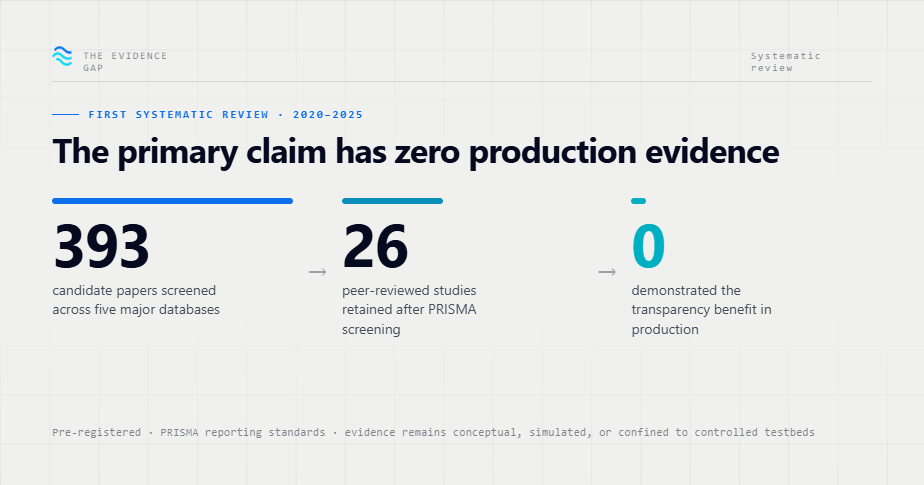 This is not an argument that decentralised AI fails. It is an argument that the field has not yet proven it succeeds. For attendees, sponsors, and professionals trying to separate genuine open infrastructure from marketing collateral, that distinction is everything.
Three Interlocked Barriers
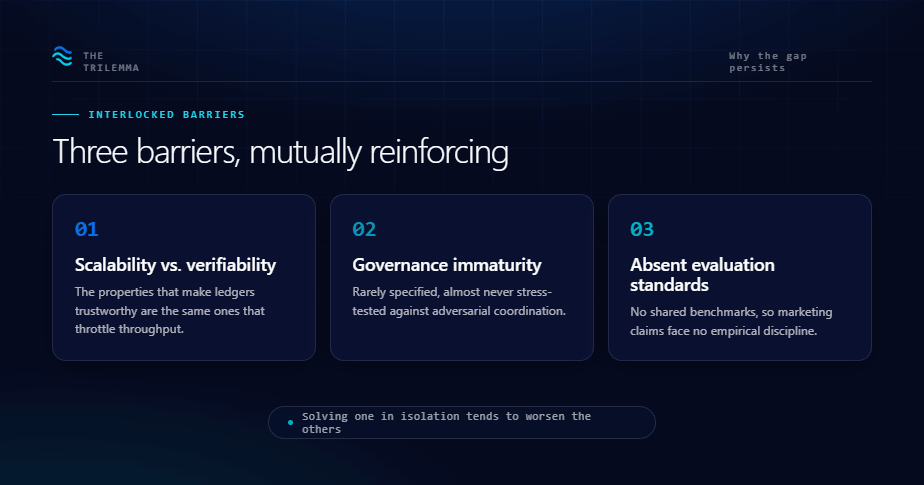
The systematic review did not just find an evidence gap. It identified why the gap persists. Three barriers recur across the literature, and they are interlocked — solving one in isolation tends to worsen the others.
Scalability vs. Verifiability
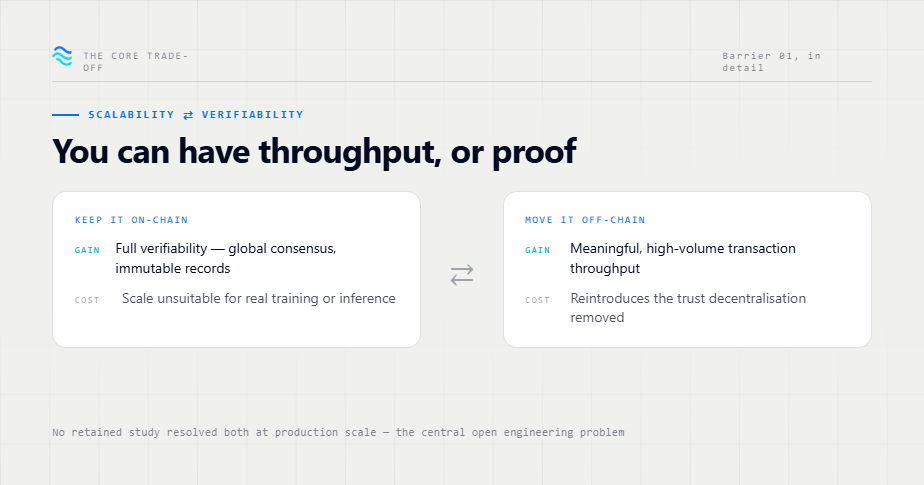
The core technical tension is structural. The properties that make blockchain-based systems trustworthy — global consensus, on-chain verification, immutable records — are precisely the properties that throttle throughput. AI workloads demand high-volume, low-latency computation. Public ledgers offer the opposite.
The reviewed studies that achieved meaningful transaction throughput typically did so by moving computation off-chain, which reintroduces the trust assumptions decentralisation was meant to remove. The studies that preserved full verifiability operated at a scale unsuitable for real model training or inference. No retained study resolved both at production scale. This is the central engineering problem of decentralised AI infrastructure, and it remains open.
 ## Governance immaturity
The second barrier is institutional rather than technical. Governance in decentralised AI systems is frequently treated as an afterthought — a token-weighted voting layer bolted onto an architecture designed for something else. The review found that governance mechanisms were rarely specified in operational detail, almost never stress-tested against adversarial coordination, and seldom designed to handle multiple stakeholder factions with divergent incentives.
This matters because governance is where decentralised AI either becomes a genuine public good or quietly recentralises. Concentrated voting power produces the same outcomes as corporate control, with less accountability and a thinner paper trail.
Absent evaluation standards
The third barrier compounds the first two. The field lacks shared benchmarks. Studies define transparency differently, measure decentralisation inconsistently, and report results that cannot be compared across projects. Without common evaluation standards, marketing claims face no empirical discipline. A project can assert that it is "fully decentralised" and "transparent" with no agreed method by which anyone could verify or refute the claim.
Why Governance Must Be Built Cross-Faction
The three barriers point to a single conclusion: governance cannot be retrofitted, and it cannot be designed by one faction for another.
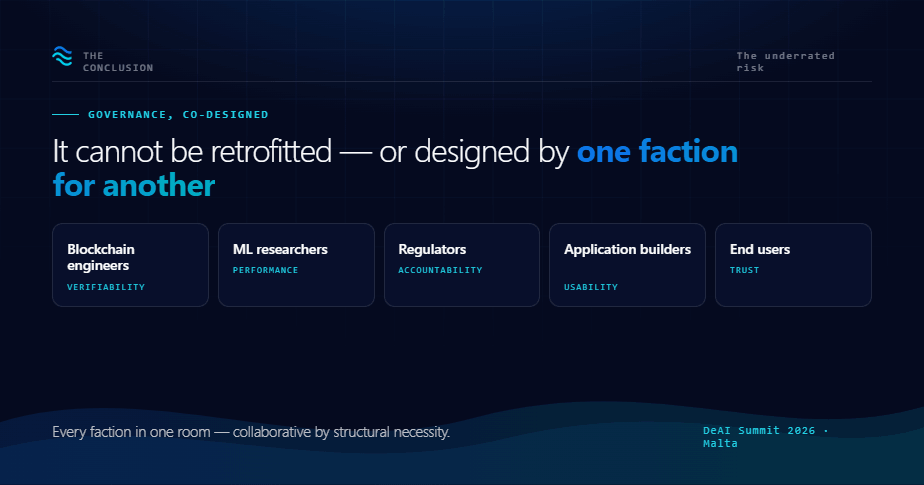 Decentralised AI sits at the intersection of competing communities — blockchain engineers, machine learning researchers, regulators, application builders, and end users. Each brings legitimate but partial priorities. Blockchain engineers optimise for verifiability. ML researchers optimise for performance. Regulators optimise for accountability. When governance is designed by any single group, it encodes that group's blind spots into the infrastructure — permanently.
 The evidence base supports a specific structural claim: durable governance for decentralised AI systems must be co-designed across factions from the outset. This is an engineering requirement derived from the observation that single-faction governance consistently fails to anticipate the failure modes other factions would have caught. The Trilemma's three barriers are mutually reinforcing in part because the communities who would solve each one have not been in the same room at the same time.
A systematic review cannot tell us how to build cross-faction governance. But it tells us why the absence of it is the field's most underrated risk.
What This Means in Practice
For those evaluating decentralised AI projects, the review offers a concrete test:
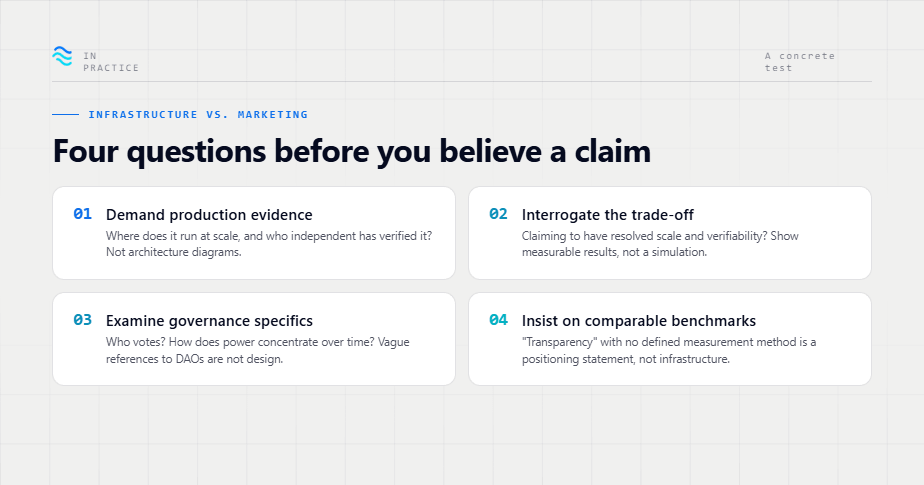 Demand production evidence, not architecture diagrams. Ask where the system runs at scale and what independent parties have verified. Conceptual proofs and controlled testbeds are not substitutes.
Interrogate the scalability-verifiability trade-off. Any project claiming to have resolved both should be able to show exactly how, with measurable results from a production environment — not a simulation.
Examine governance specifics. Who votes? How does power concentrate over time? What happens when stakeholders with incompatible incentives disagree? Vague references to DAOs are not governance design.
Insist on comparable benchmarks. Vague claims of "transparency" without a defined measurement method are a positioning statement, not infrastructure.
The Path Forward
The promise of decentralised AI as a public good is credible. The evidence that it currently delivers on that promise is not. Twenty-six peer-reviewed studies confirm a field rich in ambition and thin in production proof. The three barriers — scalability versus verifiability, governance immaturity, and absent evaluation standards — are interlocked and will not yield to piecemeal fixes.
The path forward runs through honest framing, shared benchmarks, and governance designed across factions rather than within them. That work requires the simultaneous presence of the people who would actually be bound by what gets built: frontier lab founders, decentralised infrastructure builders, regulators, and capital allocators. It is collaborative by structural necessity, not by preference.
 DeAI Summit 2026 convenes that conversation in Malta. If you are building, funding, or governing the next generation of decentralised AI infrastructure, the evidence base described here is the starting point.deaisummit.org